
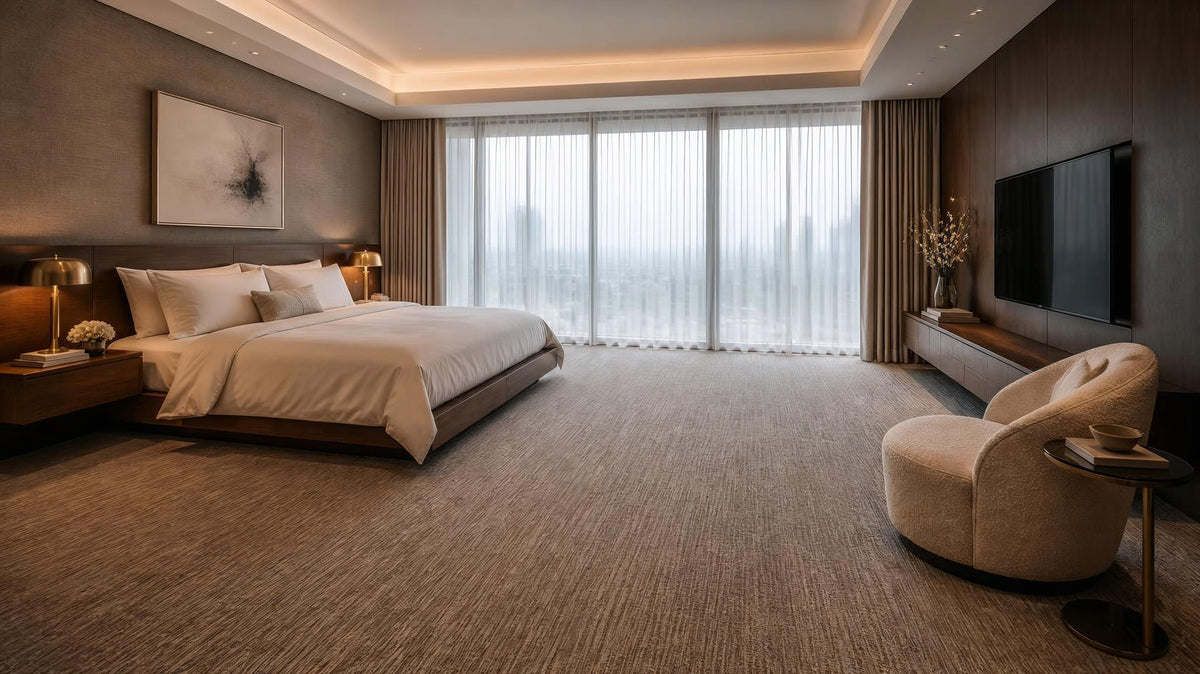
How to Assess Wool Broadloom Carpet
Wool broadloom can create a soft, textural, and visually refined wall-to-wall finish in residential, hospitality, executive, and other carefully designed interiors. It is available in different fibre compositions, pile constructions, colours, patterns, backings, and installation systems.

However, the word “wool” does not establish the quality, durability, acoustic performance, or suitability of a finished carpet. A considered buying decision should compare the exact wool broadloom product with the intended traffic, maintenance resources, subfloor condition, installation method, and design priorities.
Quick Takeaways
- Wool broadloom may contain pure wool or a blend of wool and other fibres
- Natural fibre crimp can contribute to resilience, but construction remains important
- Wool can show natural variation, shedding, shading, and tracking depending on the carpet
- Acoustic and fire performance must be assessed using product-specific documentation
- Subfloor moisture and active dampness must be addressed before installation
- Cleaning should follow the instructions written for the exact carpet
Considering wool broadloom for your space? Visit the MONLI showroom at Tampines to compare available samples, or WhatsApp +65 8112 4866 for assistance.


What Makes Wool Fibre Different?
Wool is a natural protein fibre with an inherent crimped structure. This crimp can contribute to bulk, texture, and resilience, but the performance of a carpet also depends on fibre quality, yarn preparation, twist, pile construction, pile height, density, backing, installation, and maintenance.
Wool should therefore not be evaluated using fibre content alone. Two wool carpets with similar compositions can feel and perform differently because their constructions are different.
When comparing wool broadloom, examine:
- Declared fibre composition
- Wool source where this is important to the project
- Yarn type and colour method
- Loop, cut, or cut-and-loop construction
- Pile height, density, and surface texture
- Backing and installation requirements
- Intended-use classification
- Cleaning and maintenance instructions
- Applicable warranty conditions
Pure Wool vs Wool Blends
Wool broadloom may use wool alone or combine wool with nylon or another fibre. There is no universal blend ratio, and a familiar ratio should not be assumed without checking the product specification.
| Composition | Possible Reasons for Selection | What to Verify |
|---|---|---|
| Pure Wool | Natural fibre character, tactile preference, colour, texture, or design intent | Construction, traffic suitability, shedding, cleaning, staining, backing, and warranty |
| Wool–Nylon Blend | A particular balance of wool character and synthetic-fibre properties | Exact fibre ratio, intended use, appearance retention, dye method, and maintenance |
| Other Wool Blends | Specific sheen, texture, price, colour, or manufacturing effect | Full fibre declaration, care requirements, traffic suitability, and product documentation |
A blend is not automatically better or worse than pure wool. Approval should be based on the finished carpet and the project requirements.
Pile Construction and Surface Appearance
Wool Cut Pile
Cut-pile wool broadloom can create a soft, tailored, or velvet-like surface. Depending on yarn twist and pile construction, it may show footprints, vacuum marks, shading, or changes in appearance when viewed from different directions.
Wool Loop Pile
Loop-pile wool can create a structured or textural appearance. Loop size, height, density, and pattern influence how the floor responds to traffic and furniture. Suitability for pets, wheeled furniture, and snagging risks should be considered.
Wool Cut-and-Loop
Cut-and-loop construction combines different surface textures or heights to form tonal patterns and sculpted effects. Pattern definition may change under different lighting and viewing directions.
Colour, Dyeing and Natural Variation
Wool can be produced in a wide range of colours, from natural-looking neutrals to saturated or patterned designs. The final appearance depends on fibre preparation, yarn, dye method, pile, lighting, and manufacturing process.
Do not assume wool always produces richer colour than every synthetic fibre. Compare physical samples from the actual collections being considered.
Natural and production-related variation may occur. Before ordering, ask about:
- Expected shade variation
- Dye-lot consistency
- Natural fibre variation
- Pattern or texture variation
- Pile reversal, shading, and tracking
- Sample-to-production tolerances
- Availability of matching replacement material
Where adjoining rooms must appear consistent, confirm quantities and dye-lot information before cutting or installation.
Shedding, Fuzzing and Surface Changes
Some wool carpets may release loose fibre during early use and vacuuming. The extent and duration depend on yarn, pile construction, manufacturing, installation, and maintenance. Excessive or persistent fibre loss should be assessed against the manufacturer’s guidance.
Normal appearance changes may also include:
- Footprints and vacuum marks
- Shading caused by pile direction
- Tracking in concentrated traffic areas
- Temporary furniture indentations
- Small amounts of loose fibre
- Colour differences created by lighting direction
Ask which characteristics are considered normal for the exact product before purchase.
Acoustic and Underfoot Performance
Carpet can reduce reflected sound and soften footfall compared with many hard finishes. Wool broadloom may contribute to this result, but measurable acoustic performance depends on the complete flooring assembly, including pile, backing, underlay, installation method, subfloor, and room construction.
Wool fibre alone does not establish an acoustic rating. Where a project has a numerical target, request applicable test data for the proposed carpet and floor assembly.
The underfoot feel also depends on more than fibre. Pile height, density, backing, underlay, installation method, and substrate all influence comfort.
Fire and Project Documentation
Wool has material characteristics that may influence its behaviour when exposed to heat or flame, but this does not prove that every wool carpet meets a project’s fire requirements.
Commercial, hospitality, or public-facing projects may require product-specific reports. Confirm:
- The exact product and construction tested
- The applicable test method and classification
- Whether the test includes backing, underlay, or adhesive
- The date and source of the report
- Whether the documentation is accepted by the relevant project professionals
Do not rely on general statements such as “wool is naturally fire-resistant” as a substitute for required documentation.
Where Wool Broadloom May Be Considered
Wool broadloom may suit spaces where natural fibre character, tactile quality, colour, or surface texture contributes to the design brief.
| Application | What to Consider |
|---|---|
| Bedroom | Underfoot feel, shedding, cleaning, pets, spills, furniture, and installation method |
| Living Room | Traffic, food and drink, sunlight, furniture loads, maintenance, and colour |
| Executive Office | Castor chairs, furniture, traffic, seams, maintenance, and required documentation |
| Boardroom | Appearance, chairs, acoustic objectives, cleaning access, and installation system |
| Hotel Guest Room | Luggage, housekeeping, spills, furniture layout, seams, and property requirements |
| Hospitality Public Area | Concentrated traffic, trolleys, food service, maintenance, replacement planning, and compliance |
Wool is not automatically the best choice for every premium or commercial interior. Compare it with nylon, polypropylene, blended fibres, and other constructions according to the exact application.
For commercial planning, see our Commercial Carpet Singapore: Complete Buying Guide.
Wool Broadloom vs Synthetic Carpet
| Comparison Area | How to Evaluate |
|---|---|
| Appearance and Feel | Compare physical samples under representative lighting |
| Resilience | Review complete construction and intended-use classification, not fibre alone |
| Stain Care | Check dye method, treatments, approved cleaners, and warranty exclusions |
| Acoustics | Use tested flooring-system data where a numerical target exists |
| Maintenance | Compare vacuuming, spot-cleaning, and restorative-cleaning requirements |
| Cost | Compare supply, wastage, installation, care, and replacement requirements |
| Project Documentation | Verify fire, emissions, environmental, or other required reports for the exact product |
See our Wool vs Synthetic Carpet Singapore comparison and Nylon Broadloom Carpet Singapore guide.
Moisture and Singapore Site Conditions
Wool is hygroscopic, meaning it can interact with moisture in the surrounding air. This property should not be presented as a humidity-control system or a guarantee against mould.
Persistent dampness, leaks, wet substrates, trapped moisture, or inappropriate cleaning can affect wool carpet and the flooring system beneath it. Air-conditioning alone does not resolve an active moisture problem.
Before installation:
- Assess subfloor soundness, flatness, cleanliness, and moisture condition
- Investigate leaks, dampness, or condensation
- Identify existing adhesives, coatings, tiles, and contaminants
- Follow the requirements of the carpet and installation system
- Use an appropriate moisture test where required
- Specify remediation only after understanding the moisture source
A moisture barrier, antimicrobial coating, or fungicidal primer is not a universal requirement and must be compatible with the complete flooring system.
Installation and Underlay
Wool broadloom does not always require the same installation method or underlay. Depending on the carpet and application, it may use stretch-in, direct-stick, double-bond, or another manufacturer-approved system.
Before ordering, confirm:
- Roll width, direction, and available quantity
- Room dimensions and seam positions
- Pattern repeat where applicable
- Backing and installation method
- Underlay requirements and compatibility
- Subfloor preparation
- Door, stair, and transition details
- Material allowance and replacement stock
Broadloom may require seams depending on the room and roll dimensions. Seam visibility is influenced by carpet construction, colour, lighting, pile direction, pattern, placement, and workmanship; no broadloom installation should be promised as completely invisible.
Cleaning and Maintenance
Wool carpet should be maintained according to the written guide for the exact product. Avoid assuming that all wool carpets require the same cleaner, pH range, vacuum head, extraction method, or professional-cleaning schedule.
A maintenance plan may include:
- Suitable entrance soil control
- Routine vacuuming using compatible equipment
- Prompt blotting of spills
- Only manufacturer-approved spot-cleaning products
- Periodic inspection of seams and traffic zones
- Interim or restorative cleaning when required
- Professional treatment where the contaminant or carpet warrants it
Do not assume residual lanolin makes finished wool carpet stain-proof. Fibre processing and carpet construction vary, and every spill should be handled according to the product instructions.
For stain response, read our Carpet Stain Removal Singapore guide.
Moths and Other Textile Insects
As a natural animal fibre, wool can be susceptible to textile insects under certain conditions. The level of risk depends on product treatment, storage, cleanliness, building conditions, and local pest activity.
Ask whether the selected carpet has a relevant protective treatment and what maintenance or warranty conditions apply. Regular inspection and removal of accumulated debris in low-disturbance areas, such as beneath furniture and along edges, can support early detection.
Custom Wool Carpet Options
Custom production may be considered when an available wool broadloom does not meet the required colour, pattern, size, or construction. Custom routes may involve minimum quantities, sampling, approval stages, production tolerances, and longer project planning.
Review suitable stock collections first. If customisation is necessary, see our Custom Carpet Singapore: Complete Design & Buying Guide.


What Affects Wool Broadloom Cost?
A project-specific quotation is more reliable than a generic price tier. Wool broadloom cost depends on the exact product and complete installation scope.
| Cost Factor | Why It Matters |
|---|---|
| Fibre composition | Wool percentage, blend, yarn, and material sourcing affect product cost |
| Pile and construction | Pile height, density, texture, pattern, backing, and manufacturing method affect pricing |
| Colour and customisation | Custom colours, patterns, sampling, and minimum quantities may add development work |
| Room layout | Roll planning, seams, pattern repeat, stairs, irregular spaces, and wastage affect material quantity |
| Subfloor preparation | Removal, repair, levelling, cleaning, or moisture remediation may be required |
| Installation system | Underlay, adhesive, grippers, seams, trims, and transitions affect labour and materials |
| Logistics | Stock location, freight, site access, furniture movement, and scheduling affect the quotation |
| Replacement material | Additional carpet retained for future repairs increases the initial order quantity |
Contact MONLI with your floor plan, intended application, preferred carpet, existing floor condition, and project timeline for a project-specific quotation.
FAQs
Is wool broadloom suitable for Singapore’s climate?
It can be when the product, subfloor, installation system, ventilation, and maintenance are appropriate. Active leaks or persistent dampness must be resolved before installation.
Is pure wool better than a wool blend?
Not automatically. Compare fibre composition, construction, intended use, appearance, cleaning requirements, documentation, and price for the exact products.
Does wool carpet provide better acoustic performance than synthetic carpet?
Not necessarily. Acoustic performance depends on pile, backing, underlay, substrate, and the complete flooring assembly. Use comparative test data where a numerical target exists.
Does wool carpet cause allergies?
This cannot be answered universally. Individual sensitivities, dust, cleaning, ventilation, and indoor conditions vary. Seek appropriate health advice where allergies are a concern.
Does wool broadloom always need an underlay?
No. Underlay requirements depend on the product, backing, installation method, subfloor, application, and manufacturer’s instructions.
How long does wool broadloom last?
There is no universal lifespan. Service life depends on construction, traffic, installation, maintenance, spills, environmental conditions, and appearance expectations.
Is wool broadloom always more expensive than synthetic carpet?
No. Wool is often positioned at a higher price, but the actual comparison depends on collection, construction, design, availability, quantity, and installation scope.
Related Reading
- Wool vs Synthetic Carpet Singapore — Comparison
- Nylon Broadloom Carpet Singapore: Buying Guide
- Carpet Tile vs Broadloom Singapore — Comparison
- Commercial Carpet Singapore: Complete Buying Guide
- Deep Cleaning Carpet Singapore: Complete Guide
Visit the MONLI showroom at 12 Tampines North Drive 4, #01-17, Stellar @ Tampines, Singapore 529435 to compare wool broadloom samples.
WhatsApp +65 8112 4866 for product and project assistance.
Browse Broadloom Carpets


Share:
Nylon Broadloom Carpet Singapore: Buying Guide
Ballroom Carpet Singapore: Event Space Buying Guide