
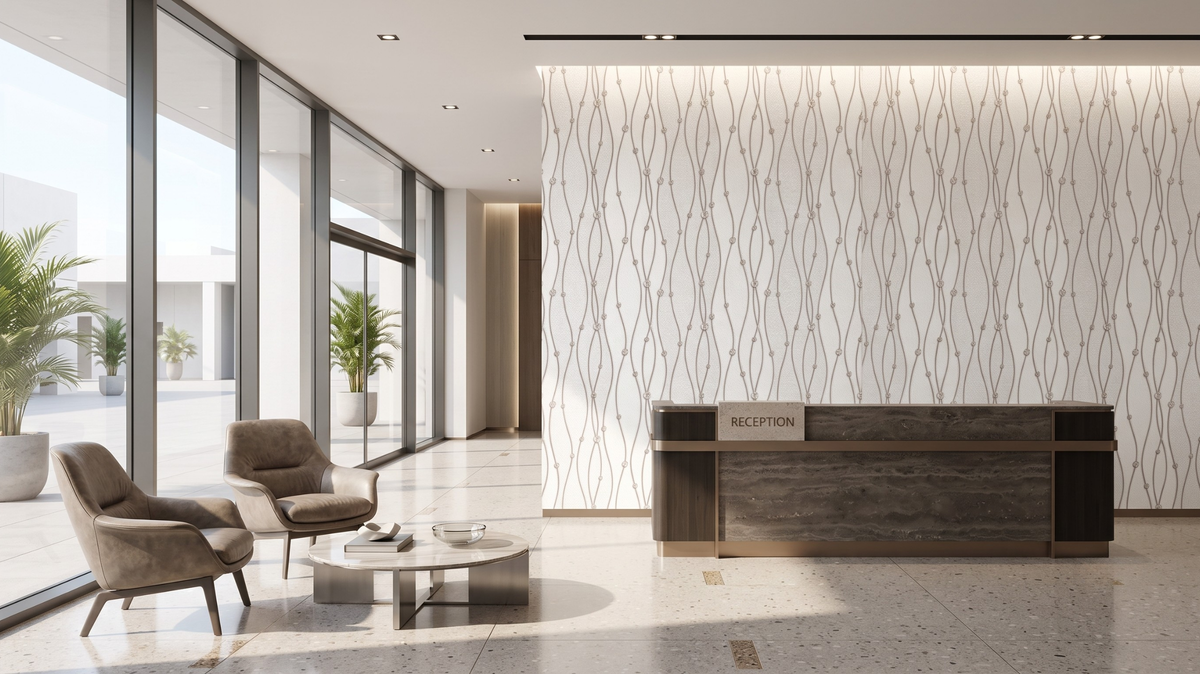
Choosing Wallpaper for Hotels in Singapore
Hotel interiors have to perform differently from residential spaces. A guest room, lift lobby, corridor and main reception area may all belong to the same property, but each experiences different levels of contact, cleaning, lighting and operational wear.
Wallpaper and commercial wallcoverings give hospitality designers more ways to introduce texture, pattern, colour and large-scale artwork without relying entirely on paint, timber, stone or built-in architectural finishes.
For hotel operators, however, appearance is only one part of the decision. Material durability, housekeeping procedures, replacement planning, substrate condition, technical documentation and the ability to refurbish an operating property should all be considered before the final specification is approved.
Quick Takeaways
- Specify by hotel zone: guest rooms, corridors, lift lobbies and public areas have different durability, cleaning and design requirements.
- Plan for housekeeping: check the manufacturer's cleaning and maintenance instructions for the exact wallcovering before specifying it for high-contact areas.
- Do not confuse decoration with acoustic treatment: some thicker wallcoverings may contribute surface softness, but dedicated acoustic performance requires suitable tested systems.
- Think beyond installation day: batch consistency, replacement stock, phased refurbishment and technical documentation matter on larger hospitality projects.
Planning a hotel refurbishment or hospitality fit-out? Visit the MONLI showroom in Tampines to compare commercial wallcovering samples in person, or WhatsApp +65 8112 4866 to discuss your project.


Why Wallpaper Works Well in Hotel Interiors
Hotels use interior finishes to create a consistent guest experience from arrival to the guest room. Walls are an important part of that experience because they form the background to lighting, furniture, flooring, artwork, signage and architectural details.
Wallpaper can introduce visual depth that would be difficult to achieve with standard paint alone.
Depending on the property concept, wallcoverings can help:
- Create a distinctive reception or lobby focal point
- Frame guest-room headboards
- Add texture to long hotel corridors
- Differentiate executive floors or suite categories
- Create identity in lift lobbies
- Enhance ballroom and function-space foyers
- Introduce local or brand-inspired artwork
- Refresh interiors without adding extensive built-in finishes
Choosing Wallpaper by Hotel Zone
A hotel should not automatically use one wallcovering specification across the entire property. Each area should be evaluated according to its visual role, expected contact and maintenance requirements.
| Hotel Zone | What to Consider | Possible Design Direction |
|---|---|---|
| Guest room | Comfort, housekeeping, furniture contact and lighting | Textured neutrals, linen effects, subtle patterns |
| Headboard wall | Main visual focal point and relationship with bed, lighting and artwork | Feature texture, mural or coordinated pattern |
| Guest corridor | Luggage, housekeeping traffic and repeated visual rhythm | Practical wallcovering with controlled pattern and suitable maintenance characteristics |
| Lift lobby | Higher contact, directional signage and first impression on each floor | Stronger texture or floor-specific feature treatment |
| Main lobby | Brand identity, scale, lighting and guest photography | Large-format texture, mural or statement wallcovering |
| Executive lounge | Premium atmosphere and closer viewing distance | Refined textures and more detailed finishes |
| Ballroom foyer | Large wall areas, event photography and high traffic | Architectural texture or large-scale decorative treatment |
| Serviced apartment | Longer guest stays, residential feel and regular maintenance | Warm, versatile designs suited to extended use |
Selecting the Right Wallcovering for Hospitality Spaces
There is no single material that is automatically the best hotel wallpaper. Product construction, surface finish, backing and technical characteristics can differ considerably.
The appropriate specification should reflect the actual location and operating requirements.
Commercial Vinyl Wallcoverings
Commercial vinyl wallcoverings are worth considering in hospitality areas where surface durability and easier maintenance are priorities.
Products vary in thickness, backing, abrasion resistance, washability and intended application, so the technical data for the individual wallcovering should be reviewed before selection.
Consider for: guest corridors, lift lobbies, guest rooms and other areas where higher-contact performance may be required.
Fabric-Backed Wallcoverings
Fabric-backed constructions can provide additional dimensional stability and robustness compared with lighter decorative wallcoverings, depending on the product.
They are commonly considered for commercial interiors where the wall finish may experience more contact than in a typical home.
Consider for: corridors, public areas and hospitality applications requiring a more substantial wallcovering construction.
Textured Wallcoverings
Textured finishes can create a premium appearance without relying on strong graphic patterns.
Linen, silk-inspired, plaster, stone, timber and woven effects can work particularly well in guest rooms because they add visual depth while remaining relatively calm.
Custom Murals & Large-Format Artwork
Custom murals can turn a lobby, lift lobby or guest-room feature wall into a stronger storytelling element.
A hospitality mural might reference local architecture, landscape, cultural motifs, abstract artwork or the hotel's own brand concept.
Before production, confirm the wall dimensions, artwork resolution, furniture position, lighting, signage, switches and expected viewing distance.
Guest Room Wallpaper & Headboard Design
The wall behind the bed is usually one of the most important decorative surfaces in a hotel guest room.
A well-designed headboard wall can visually anchor the bed, coordinate bedside lighting and give the room a more finished identity without adding excessive decoration to every wall.
Possible approaches include:
- Fine linen-inspired textures
- Warm neutral wallcoverings
- Subtle geometric patterns
- Soft botanical designs
- Stone or plaster-inspired surfaces
- Custom artwork connected to the hotel's location

A subtle textured wallpaper can anchor the hotel bed and bedside lighting while keeping the guest room calm and visually comfortable
Hotel Corridors & Lift Lobbies
Guest corridors present a different challenge from bedrooms.
They can experience contact from luggage, housekeeping carts, maintenance equipment and repeated guest movement. They also contain long visual sightlines, multiple doors, signage and lighting fixtures.
When choosing corridor wallcoverings, consider:
- Expected contact level
- Cleaning requirements
- Wall protection at vulnerable locations
- Pattern repeat across long walls
- Door and skirting colours
- Emergency and directional signage
- Lighting intervals
- Future patching or replacement requirements
A very strong repeating pattern can become visually tiring across a long corridor. Controlled textures and lower-contrast patterns often provide a more flexible hospitality background.
Lobby, Reception & Public-Area Wallcoverings
The lobby has a different role again. Here, visual impact and brand identity may carry greater weight because the space establishes the guest's first impression of the property.
Large-format murals, architectural textures and more expressive wallcoverings can be considered where there is enough viewing distance.
For double-height reception areas or large atriums, pattern scale should be assessed from both close and distant viewing positions.
Lighting is especially important. Wall washers, decorative pendants, daylight and concealed lighting can reveal surface texture differently throughout the day.


Hotel Wallpaper vs Paint
Wallpaper and paint can both play useful roles in hospitality interiors. The most effective hotel specification may combine the two rather than treating them as mutually exclusive.
| Factor | Commercial Wallcovering | Commercial Paint |
|---|---|---|
| Design flexibility | Textures, patterns, murals and decorative effects | Very broad colour selection |
| Visual depth | Can provide tactile and layered finishes | Generally more colour-led unless special finishes are used |
| Maintenance | Depends on the individual wallcovering specification | Depends on paint formulation and finish |
| Local repairs | May require matching material, pattern and production batch | Touch-ups may be possible, although colour differences can appear |
| Custom graphics | Possible with suitable mural systems | Usually requires separate artwork or signage |
| Future refurbishment | Depends on material, adhesive and substrate | Can generally be repainted after suitable preparation |
Housekeeping, Cleaning & Maintenance
Hotel wall finishes are cleaned and maintained more frequently than many residential walls.
Before specifying wallpaper, the housekeeping team or project consultant should understand the manufacturer's recommended maintenance method.
Consider:
- Whether the surface can be wiped
- Permitted cleaning products
- Whether abrasive cleaning should be avoided
- Expected contact from luggage and carts
- Whether localised replacement may be required
- How replacement material will be stored
Do not assume every vinyl wallcovering is compatible with disinfectants, degreasers or strong cleaning chemicals. Care instructions vary by product.
Hotel Acoustics: What Wallpaper Can and Cannot Do
Guest-room acoustics are important, but standard decorative wallpaper should not be presented as a soundproofing system.
Some thicker, textile or specialist wallcoverings may contribute a degree of surface absorption or softness. However, room-to-room sound transmission depends primarily on the complete building assembly, including walls, doors, ceilings, floors, penetrations and junctions.
If measurable acoustic performance is required, specify dedicated acoustic products with appropriate test data rather than assuming a decorative wallcovering will provide sound insulation.
24/7 Air-Conditioning, Humidity & Wall Condition
Singapore hotels often operate air-conditioning for long periods, while exterior conditions remain warm and humid.
Temperature differences, ventilation, façade conditions and occasional introduction of warm outdoor air can influence condensation risk in some locations.
However, ambient humidity and moisture inside a wall are not the same issue.
Before wallpaper installation, inspect the substrate for:
- Recurring damp patches
- Water staining
- Mould
- Peeling or bubbling paint
- Powdery plaster
- Previous leakage repairs
- Condensation-prone areas
- Unstable previous coatings
Wallpaper should not be used to conceal an unresolved moisture or waterproofing problem.
Fire Safety & Technical Documentation
Hospitality projects may require technical documentation for interior finishes.
The exact requirements depend on the building, material location, project specification and applicable approval process.
Do not assume every wallpaper or commercial vinyl carries the same fire-performance classification.
Before final specification, project teams may need to review:
- Manufacturer technical data sheets
- Product construction and backing
- Relevant fire-performance documentation
- Cleaning and maintenance instructions
- Installation recommendations
- Adhesive compatibility
- Any consultant or property-management requirements
If a hotel consultant, operator or project team has a specific documentation requirement, share it with MONLI before confirming the material so the available product information can be checked.
Lighting & Colour Consistency Across Hotel Rooms
Hospitality projects often repeat the same finish across many rooms, which makes colour consistency particularly important.
A wallpaper that looks correct in one sample room may appear different on another floor because of daylight orientation, artificial lighting colour temperature or neighbouring materials.
Before approving a large quantity, consider reviewing the wallcovering alongside:
- Guest-room flooring
- Headboard fabric
- Curtains
- Joinery finishes
- Bedside lighting
- General room lighting
- Bathroom and entrance finishes
A physical mock-up or sample room can be particularly valuable on larger hospitality projects.
Batch Consistency & Replacement Stock
Large hotels may require the same wallcovering across dozens or hundreds of rooms.
Production batches can matter because slight colour or texture variations may occur between manufacturing runs for some products.
For larger projects, consider:
- Confirming required quantities before ordering
- Allowing for pattern repeat and installation waste
- Checking batch information where applicable
- Keeping suitable replacement stock
- Recording product codes and specifications
- Planning how replacement material will be stored
This can make future maintenance easier if a wall section is damaged after the main refurbishment has been completed.
Phased Refurbishment for Operating Hotels
Renovating an operating hotel requires a different installation strategy from an empty construction site.
Taking too many rooms out of service at the same time can affect hotel operations, while working around occupied areas may impose restrictions on contractor movement, noise and working hours.
A phased programme may be organised by room, zone or floor depending on the property.
Before scheduling wallpaper work, consider:
- Room occupancy
- Housekeeping schedules
- Permitted contractor hours
- Guest circulation
- Service-lift access
- Furniture protection and movement
- Wall preparation time
- Material storage
- Other renovation trades
- Required room handover date
Discuss the actual project programme with MONLI before confirming installation dates, especially when work must be coordinated around live hotel operations.
Wall Preparation Before Hotel Wallpaper Installation
Commercial wallcoverings still depend on a suitable substrate.
Before installation, walls should be assessed for:
- Moisture
- Mould
- Loose paint
- Cracks
- Powdery plaster
- Uneven repairs
- Previous adhesive residue
- Surface contamination
The preparation method depends on the existing wall and proposed wallcovering system.
Significant water ingress, unstable plaster or other underlying defects should be rectified before decorative installation begins.
How Much Does Hotel Wallpaper Cost in Singapore?
Hotel wallpaper pricing varies significantly because hospitality projects can range from one boutique-hotel feature wall to hundreds of guestrooms and multiple public areas.
A single generic per-square-metre figure may therefore be misleading without understanding the project specification.
| Cost Factor | Why It Affects the Project |
|---|---|
| Wallcovering specification | Material construction, brand, finish and technical characteristics affect pricing |
| Project quantity | A single suite and a multi-floor refurbishment require different quantities and logistics |
| Pattern repeat | Larger repeats may increase material consumption |
| Custom murals | Artwork preparation, dimensions and printing specifications affect scope |
| Wall condition | Repair and preparation may be required before installation |
| Installation access | Lift access, restricted hours and occupied floors can influence project planning |
| Wall height | Atriums, ballrooms and tall lobby walls may require additional access planning |
| Phased refurbishment | Multiple mobilisation and room-release stages can affect logistics |
| Replacement stock | Additional material may be retained for future maintenance |
For a useful project quotation, provide MONLI with wall dimensions or drawings, site photographs, preferred materials, estimated quantities and any relevant technical or scheduling requirements.
Hotel Wallpaper Specification Checklist
- Define the hotel zone: guest room, corridor, lobby, lift lobby or function area.
- Confirm expected contact: consider guests, luggage and housekeeping equipment.
- Review cleaning requirements: check the manufacturer's maintenance instructions.
- Inspect the substrate: identify moisture, cracks or unstable coatings.
- Check technical requirements: obtain relevant documentation before final approval.
- Coordinate lighting: review physical samples under representative hotel lighting.
- Confirm quantities: include pattern repeat, waste and replacement stock where appropriate.
- Check batch consistency: especially for finishes repeated across many guestrooms.
- Plan installation sequencing: coordinate around occupancy and other trades.
- Create a maintenance record: retain product codes, care instructions and spare material information.
Common Hotel Wallpaper Mistakes to Avoid
Using One Specification Everywhere
A guest-room headboard and a high-contact corridor wall do not necessarily require the same wallcovering.
Treating Wallpaper as Soundproofing
Decorative wallcovering should not replace a properly designed acoustic system where measurable noise control is required.
Ignoring Housekeeping Requirements
A visually attractive finish may still be unsuitable if the maintenance method required by the hotel is incompatible with the product.
Ordering Without Replacement Planning
Future repairs can become more difficult if the product code, production information and spare material are not retained.
Skipping the Sample Room
Colour, texture and pattern scale can behave differently across a full hotel room than on a small sample.
Installing Over Problem Walls
Wallpaper should not be used to hide moisture, mould, unstable paint or unresolved substrate defects.
Frequently Asked Questions
Is wallpaper suitable for hotels in Singapore?
Yes, when the wallcovering is selected for the actual hotel zone, wall condition, maintenance requirements and project specification. Commercial hospitality areas may require different products from standard residential applications.
What wallpaper is suitable for hotel guest rooms?
Commercial vinyl, fabric-backed and other hospitality-suited wallcoverings may be considered depending on the desired design, expected contact, housekeeping procedures and technical requirements. The individual product specification should be checked before approval.
Can hotel wallpaper be cleaned by housekeeping?
Many commercial wallcoverings are designed for easier maintenance, but permitted cleaning methods vary. Follow the manufacturer's care instructions for the exact material rather than assuming all vinyl surfaces tolerate the same chemicals.
Does hotel wallpaper provide soundproofing?
Standard decorative wallpaper should not be treated as soundproofing. Some specialist or thicker products may contribute surface absorption, but room-to-room noise control requires appropriate acoustic construction and tested systems.
Can hotel wallpaper be installed while the property remains open?
Potentially. Phased refurbishment can be planned around occupied areas, but the programme depends on room availability, contractor-access requirements, wall preparation, installation scope and other trades.
What should a hotel prepare before requesting a wallpaper quotation?
Provide drawings or wall dimensions where available, site photographs, room quantities, preferred finishes, wall conditions, installation schedule and any technical-documentation requirements. This allows a more useful project assessment and quotation.
Related Commercial Wallpaper Guides
- Retail Wallpaper Singapore: Complete Guide
- Restaurant Wallpaper Singapore: Complete Guide
- Vinyl Wallpaper Singapore: Complete Buying Guide
- Wallpaper Humidity Singapore: Causes & Prevention Guide
Plan Your Hotel Wallpaper Project with MONLI
The best hotel wallcovering should support both the guest experience and the operational requirements of the property.
Start by defining each hotel zone, then consider design, expected contact, housekeeping, lighting, substrate condition, technical requirements and future maintenance. For larger projects, plan batch consistency, replacement stock and installation sequencing before placing the final material order.
Explore MONLI's Wallpaper Singapore collection, visit the MONLI showroom in Tampines to compare physical samples, or WhatsApp +65 8112 4866 to discuss hospitality wallcovering options and request a project quotation.


Share:
Restaurant Wallpaper Singapore: Design & Material Guide
Grey Wallpaper Singapore: Modern Interior Design Ideas