
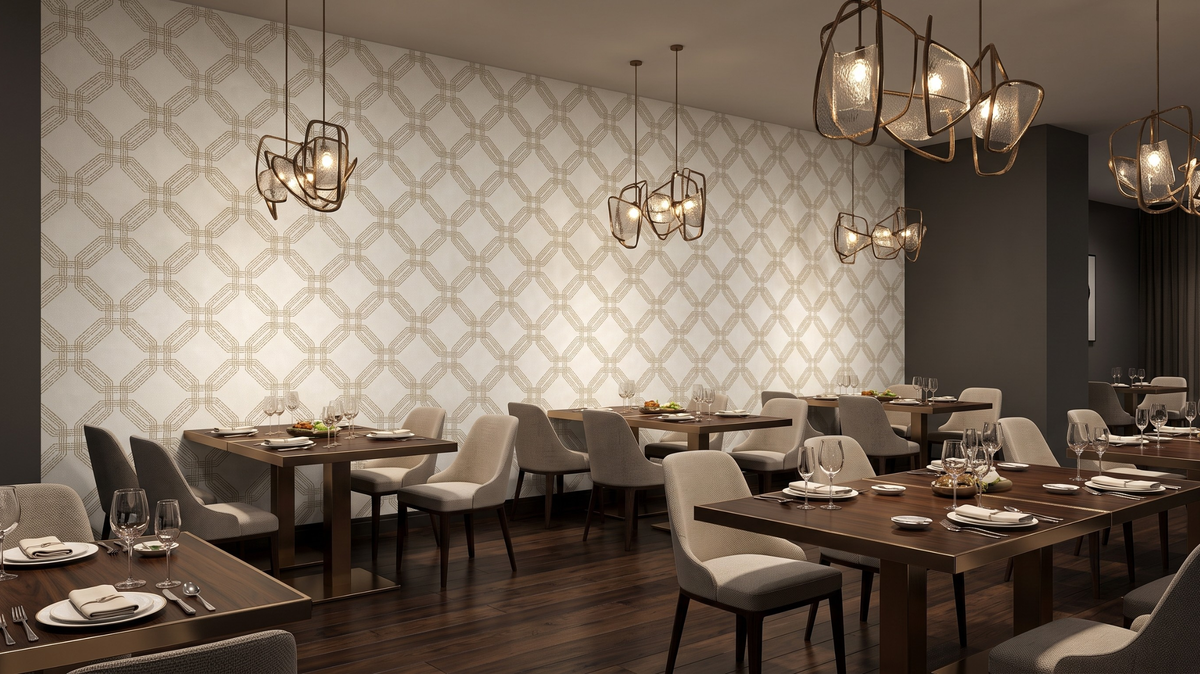
Choosing Wallpaper for Restaurants in Singapore
In a restaurant, walls do more than complete the interior. They help establish the mood of the dining experience, frame important customer-facing areas and influence how furniture, lighting, signage and food presentation work together.
Wallpaper can introduce colour, texture, pattern and large-scale artwork without requiring every decorative surface to be constructed from timber, stone, tile or architectural panels.
However, F&B interiors also present challenges that are less common in residential spaces. Frequent customer contact, cleaning, steam, food splashes, changing temperatures, operating hours and landlord requirements can all influence which wall finish is appropriate.
Quick Takeaways
- Choose by restaurant zone: a dining-room feature wall has different requirements from a corridor, bar backdrop or wall near food service.
- Check cleaning requirements: some vinyl-surfaced wallcoverings are easier to maintain, but care instructions vary by product.
- Inspect the wall first: dampness, unstable paint, cracks and unresolved seepage should be addressed before wallpaper installation.
- Plan around operations: coordinate material selection, landlord requirements and installation scheduling before confirming the fit-out programme.
Planning a restaurant, cafe or F&B interior? Visit the MONLI showroom in Tampines to compare wallpaper samples in person, or WhatsApp +65 8112 4866 to discuss your project.


Why Wallpaper Works Well in Restaurant Interiors
Restaurant interiors are highly visual environments. Customers experience the walls alongside lighting, tables, seating, flooring, music, signage and food presentation.
A carefully selected wallcovering can help establish a distinctive concept without overwhelming the dining space.
Depending on the restaurant design, wallpaper can be used to:
- Create a memorable entrance feature
- Frame a hostess or reception area
- Add depth behind booth or banquette seating
- Define a bar or beverage-service zone
- Create a backdrop for private dining rooms
- Introduce artwork or brand storytelling
- Provide a background for customer photographs
- Visually separate different dining zones
Choosing Wallpaper by Restaurant Zone
Not every restaurant wall experiences the same level of contact, cleaning or environmental exposure. Selecting wallcovering by zone is therefore more useful than applying one specification throughout the entire venue.
| Restaurant Zone | What to Consider | Possible Design Direction |
|---|---|---|
| Entrance & hostess area | First impression, signage, lighting and customer photography | Statement texture, mural or brand-led design |
| Main dining room | Ambience, furniture, lighting and overall visual balance | Textured neutrals, patterns or selected feature walls |
| Banquette seating | Customer proximity, contact and cleaning requirements | Wallcovering selected with maintenance in mind |
| Bar backdrop | Lighting, shelving, bottles, signage and visual contrast | Darker texture, architectural pattern or feature design |
| Private dining room | Atmosphere, privacy and more intimate viewing distance | Richer textures, murals or stronger decorative patterns |
| Corridors | Higher contact from staff and customers | Practical finish with suitable maintenance characteristics |
| Kitchen-adjacent dining | Heat, steam, ventilation and cleaning frequency | Product selection based on actual site conditions and specifications |

A darker geometric wallcovering can give a restaurant bar stronger visual identity when coordinated with shelving, lighting and surrounding finishes
Selecting the Right Wallcovering for F&B Spaces
There is no single wallpaper material that is automatically suitable for every restaurant.
The correct choice depends on the wall, restaurant zone, maintenance expectations, ventilation and technical requirements of the project.
Vinyl-Surfaced Wallcoverings
Vinyl-surfaced wallcoverings are worth considering in customer-facing areas where easier surface maintenance is important.
Different products have different levels of washability, abrasion resistance and chemical compatibility, so cleaning instructions should be checked for the exact wallcovering being specified.
Consider for: dining areas, corridors, banquette zones and other locations where a more practical decorative surface is preferred.
Non-Woven Wallpaper
Non-woven wallpaper provides a broad range of decorative options and can work well in areas where design flexibility is more important than frequent intensive cleaning.
Consider for: private dining rooms, feature walls, reception areas and lower-contact decorative zones, subject to the individual product specification.
Textured Wallcoverings
Textured designs can introduce depth without relying on a strong repeating graphic.
Linen, plaster, stone, concrete and fabric-inspired effects can complement timber furniture, warm lighting and architectural finishes commonly used in restaurants.
Custom Murals & Brand Graphics
A custom mural can turn a plain wall into a visual storytelling element.
Depending on the concept, it may incorporate illustrations, local references, brand motifs, abstract artwork or imagery related to the restaurant's cuisine.
Before producing a mural, confirm:
- Exact wall dimensions
- Artwork resolution
- Viewing distance
- Position of tables and seating
- Lighting direction
- Switches and sockets
- Signage placement
- Shelving or decorative objects
- Whether customers are likely to photograph the wall
Restaurant Wallpaper vs Paint vs Wall Tiles
Wallpaper, paint and tile all have useful roles in F&B interiors. The best solution depends on where the finish is being used and what performance is required.
| Factor | Wallpaper / Wallcovering | Paint | Wall Tile |
|---|---|---|---|
| Design flexibility | Patterns, textures, murals and decorative effects | Very broad colour selection | Colour, format, pattern and surface texture vary by tile |
| Custom graphics | Possible with suitable mural systems | Usually requires separate artwork or signage | Usually requires separate artwork or signage |
| Surface maintenance | Depends on the individual product | Depends on paint formulation and finish | Generally practical, but grout and joints also require maintenance |
| Installation | Depends on wall preparation, material and pattern complexity | Requires preparation and drying between coats | Requires suitable substrate, setting materials and installation work |
| Visual character | Wide range from subtle texture to large-scale artwork | Effective for simple colour-based schemes | Strong material character depending on tile selection |
| Future changes | Depends on wallcovering and installation system | Can usually be repainted | Removal may require more substrate repair |
Many successful restaurant interiors combine several finishes instead of forcing one material to perform every role.
For example, tile may be appropriate where the design or maintenance requirement calls for it, paint can provide a neutral background, and wallpaper can be reserved for dining areas where stronger visual identity is desired.


Cleaning & Maintenance in Restaurant Areas
Cleaning requirements should be considered before selecting the wallcovering, not after installation.
A feature wall above a dining banquette may have very different maintenance needs from a narrow corridor where staff and customers regularly brush against the surface.
| Exposure Level | Example Areas | Selection Priority |
|---|---|---|
| Lower exposure | High feature walls, decorative mural areas | Design and visual impact |
| Moderate exposure | Main dining room, private dining, reception | Balance aesthetics with appropriate maintenance |
| Higher contact | Corridors, queue areas, banquette walls | Check cleaning and durability specifications carefully |
| Higher environmental exposure | Areas closer to food service, steam or open-kitchen interfaces | Assess heat, moisture, ventilation and cleaning requirements before specification |
Do not assume that every vinyl wallcovering can tolerate strong degreasers or disinfectants. Follow the manufacturer's cleaning instructions for the selected product.
Open Kitchens, Steam & Grease Exposure
Restaurants with open kitchens or hot food service areas require additional planning.
Airborne grease, steam and temperature changes can affect nearby decorative surfaces, but exposure levels vary greatly depending on ventilation, cooking method, distance and layout.
Before installing wallpaper near these areas, consider:
- Distance from cooking equipment
- Extraction and ventilation
- Direct exposure to steam
- Cleaning frequency
- Expected grease accumulation
- Wall temperature
- Product maintenance instructions
Wallpaper should not be installed where the selected product is unsuitable for the actual environmental or hygiene requirements.
Restaurant Acoustics: What Wallpaper Can and Cannot Do
Busy restaurants often contain hard surfaces such as glass, stone, tile and timber that reflect sound.
Some thicker or textile-based wallcoverings may contribute a degree of surface softness, but standard decorative wallpaper should not be treated as an acoustic-control system unless the specific product has tested acoustic performance.
If reverberation or speech intelligibility is a major concern, the interior design may require dedicated acoustic materials in addition to decorative wall finishes.
This distinction is important because visual texture alone does not prove measurable acoustic performance.
Restaurant Lighting & Food Photography
Wallpaper colour and texture can change significantly under restaurant lighting.
Warm pendant lights, spotlights, concealed LED strips and daylight from storefront glazing can all affect how a wallcovering appears.
This is especially important for restaurants where customers regularly photograph food or interiors.
Consider how the wallpaper will interact with:
- Table lighting
- Food presentation
- Brand colours
- Furniture upholstery
- Flooring
- Mirrors and reflective surfaces
- Photography backgrounds
Physical samples are particularly valuable when selecting cream, beige, greige, red, green and other colours that may shift noticeably under warm restaurant lighting.
Wallpaper for Singapore Shophouse Restaurants
Singapore shophouses can provide distinctive settings for cafes, bars and restaurants, but older buildings may also present wall conditions that require more careful assessment.
Depending on the property and previous renovation history, walls may show:
- Uneven plaster
- Previous repairs
- Hairline cracking
- Old paint layers
- Moisture staining
- Powdery surfaces
- Previous adhesive residue
Wallpaper may visually reduce the appearance of minor surface variation, but it should not be expected to bridge significant cracks or solve structural and moisture problems.
Any active seepage, unstable plaster or significant cracking should be assessed and corrected before installation.
Humidity & Semi-Outdoor Dining Areas
Semi-outdoor and naturally ventilated dining spaces require different consideration from fully air-conditioned interiors.
Exposure can include higher ambient humidity, wind-driven moisture, temperature variation and—in some locations—direct rain.
Do not assume that a standard indoor wallpaper is suitable for these conditions.
If a wall is located in an alfresco or semi-outdoor area, confirm whether the selected material and installation system are specifically suitable for the actual exposure.
Walls exposed directly to rain or persistent moisture may require a different surface solution entirely.
Food-Premise Requirements & Product Documentation
Commercial F&B projects may have requirements relating to finishes, maintenance, fire safety, indoor environmental conditions or other building and operational considerations.
The applicable requirements depend on the premises, building, project and location of the material.
Do not assume that every wallpaper carries identical certifications or is suitable for every part of a food premises.
Before specifying a product, confirm:
- Where the material will be installed
- Manufacturer technical information
- Cleaning and maintenance instructions
- Backing and surface construction
- Any required fire-performance documentation
- Any landlord or project-consultant requirements
- Whether the product is suitable for the intended environment
If your landlord, consultant or building management has specified a particular requirement, share it with MONLI when discussing material selection so the available documentation for the proposed product can be checked.
Fit-Out Scheduling Around Restaurant Operations
For an operating restaurant, installation scheduling can be just as important as material selection.
The time required depends on wall dimensions, substrate condition, pattern matching, site access and the amount of preparation required.
Before scheduling work, consider:
- Restaurant operating hours
- Permitted contractor access
- When tables and furniture can be moved
- Whether other renovation trades are still working
- Wall preparation requirements
- Material delivery arrangements
- Required reopening or handover date
If after-hours work is required, discuss the actual permitted work window and project scope with MONLI before confirming the installation programme.
Wall Preparation Before Installation
A decorative finish is only as reliable as the surface behind it.
Before restaurant wallpaper is installed, check the wall for:
- Active water seepage
- Persistent dampness
- Mould
- Loose or peeling paint
- Powdery plaster
- Cracks
- Uneven repairs
- Oil or surface contamination
- Old adhesive residue
The appropriate preparation method depends on the wall and installation system. Significant moisture, contamination or structural problems should be rectified before wallpaper work begins.
Planning for Lease Reinstatement
Many restaurants operate from leased premises, so future reinstatement should be considered during the initial fit-out.
Lease requirements vary. A tenant may eventually need to remove decorative finishes and return the premises to a specified condition.
If future removal is important, discuss it before selecting the wallcovering.
Consider:
- Wallcovering construction
- Adhesive system
- Underlying substrate
- Removal method
- Potential repair after removal
- Landlord reinstatement requirements
No wallpaper should be assumed to remove without any effect on the underlying wall. Results depend on the material, adhesive, substrate and condition of the wall at the time of removal.
How Much Does Restaurant Wallpaper Cost in Singapore?
Restaurant wallpaper costs vary too widely for a single generic price to be useful.
A small cafe feature wall, a custom restaurant mural and a multi-zone dining-room installation have very different requirements.
| Cost Factor | Why It Affects the Project |
|---|---|
| Wallcovering material | Different products, brands, constructions and finishes have different pricing |
| Wall dimensions | Width and height determine material quantity |
| Pattern repeat | Larger repeats can increase material requirements |
| Custom mural artwork | Dimensions, artwork preparation and printing requirements affect the scope |
| Wall condition | Repair, cleaning or preparation may be required before installation |
| Restaurant access | Restricted work windows and site procedures can affect scheduling |
| Installation complexity | High walls, corners, doors, banquettes and fixed furniture can increase complexity |
| Project scale | A single feature wall and a complete restaurant fit-out require different quantities and labour |
For a more useful quotation, provide MONLI with wall dimensions, photos of the existing surface, the preferred wallcovering and any relevant landlord or fit-out requirements.
What to Check Before Ordering Restaurant Wallpaper
- Measure accurately: record wall width and height and note major openings.
- Inspect the substrate: identify moisture, cracks, loose paint or contamination.
- Define the restaurant zones: determine which walls have higher contact or environmental exposure.
- Review cleaning requirements: check the manufacturer's care instructions.
- Coordinate furniture: account for banquettes, tables, counters and shelving.
- Check lighting: view samples under lighting similar to the actual venue.
- Plan custom artwork: confirm mural dimensions and resolution before production.
- Confirm project requirements: check landlord, building-management and consultant requirements.
- Plan installation: coordinate access with restaurant operating hours and other trades.
- Consider reinstatement: understand lease requirements before choosing the installation system.
Common Restaurant Wallpaper Mistakes
Choosing Only for Appearance
A beautiful wallpaper may still be unsuitable for a location requiring frequent cleaning or exposed to challenging environmental conditions.
Installing Too Close to Unsuitable Food-Preparation Areas
Decorative wallpaper should only be used where its product specification and maintenance requirements are appropriate for the actual location.
Ignoring Ventilation & Moisture
Steam, condensation and unresolved wall moisture should be considered before installation.
Assuming Every Vinyl Is the Same
Vinyl-surfaced products vary in construction, backing, washability and intended use.
Choosing Artwork Before the Furniture Plan
A mural can lose its focal point when important elements are later covered by furniture, signage or shelving.
Leaving Fit-Out Requirements Until the Last Minute
Contractor access, material documentation and permitted work hours can affect the installation programme.
Frequently Asked Questions
Is wallpaper suitable for restaurants and cafes in Singapore?
Yes, when the selected wallcovering is appropriate for the location, wall condition and maintenance requirements. Restaurants should also consider ventilation, customer contact, cleaning and any landlord or project requirements.
Can food stains and grease be cleaned from restaurant wallpaper?
It depends on the product. Some vinyl-surfaced wallcoverings are designed for easier cleaning, while other decorative materials require gentler care. Always follow the manufacturer's maintenance instructions.
Can wallpaper be used near an open kitchen?
Possibly, but suitability depends on distance from cooking equipment, heat, steam, grease exposure, ventilation and the product specification. Higher-exposure locations may require a different wall finish.
Can wallpaper be used in alfresco restaurant areas?
Only when the selected material and installation system are suitable for the actual exposure. Standard indoor wallpaper should not automatically be used in areas exposed to direct rain, persistent moisture or demanding outdoor conditions.
Can MONLI install restaurant wallpaper outside operating hours?
Scheduling depends on project scope, site requirements and installer availability. Provide the permitted work window when requesting a quotation so the installation programme can be assessed.
Can restaurant wallpaper be removed when the lease ends?
Many wallcoverings can be removed, but the process and condition of the underlying wall depend on the material, adhesive and substrate. If reinstatement is important, discuss removal requirements before product selection.
Related Commercial Wallpaper Guides
- Retail Wallpaper Singapore: Complete Guide
- Hotel Wallpaper Singapore: Complete Guide
- Wallpaper vs Paint Singapore: Which Is Better?
- Wallpaper Humidity Singapore: Causes & Prevention Guide
Plan Your Restaurant Wallpaper Project with MONLI
The best restaurant wallcovering should support the dining concept, customer experience and practical requirements of the space.
Start by identifying the most important customer-facing walls, then evaluate contact level, cleaning requirements, ventilation, lighting, furniture and wall condition. For commercial projects, confirm any landlord or technical-documentation requirements before final material approval.
Explore MONLI's Wallpaper Singapore collection, visit the MONLI showroom in Tampines to compare physical samples, or WhatsApp +65 8112 4866 to discuss product selection and request a project quotation.


Share:
Retail Wallpaper Singapore: Design & Material Guide
Hotel Wallpaper Singapore: Design & Material Guide