
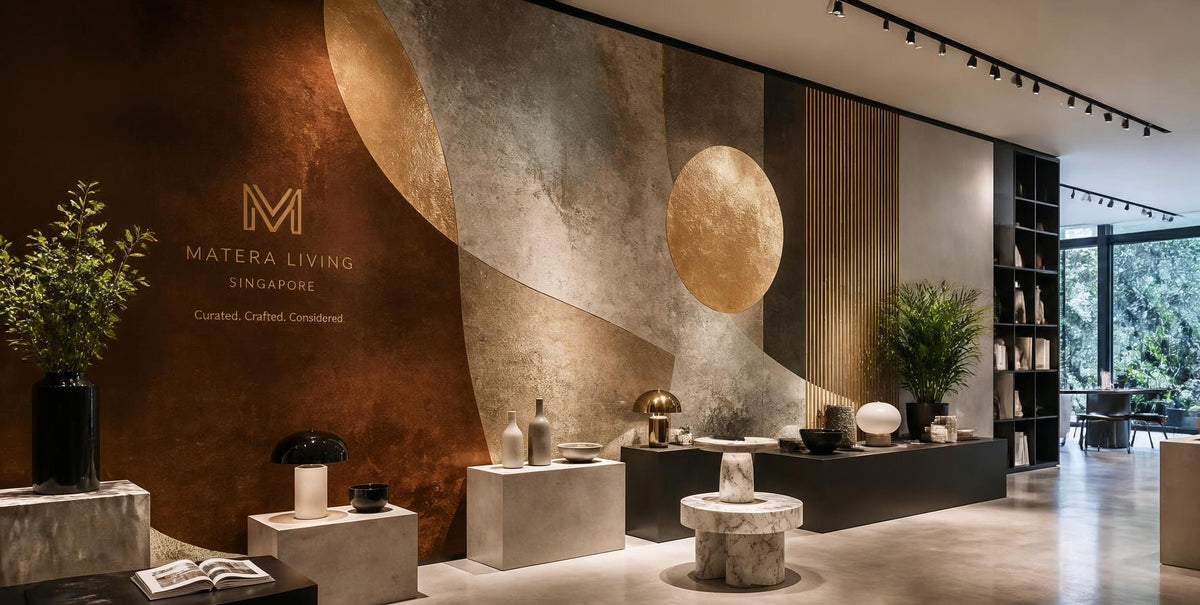
Choosing Wallpaper for Retail Spaces in Singapore
In a retail environment, walls are more than background surfaces. They influence how customers perceive the brand, products and overall store experience from the moment they enter.
Wallpaper and other decorative wallcoverings can help create feature walls, branded display zones, fitting-room environments and cashier backdrops without relying entirely on built-in carpentry or decorative panels.
But retail spaces also have practical requirements that residential interiors may not face. Customer contact, cleaning, product displays, lighting, mall fit-out procedures, installation access and lease reinstatement can all affect which wall finish is suitable.
Quick Takeaways
- Choose for the retail zone: entrance walls, cashier areas, fitting rooms and product displays can have very different durability and design requirements.
- Check product specifications: cleaning, surface durability and any required fire-safety documentation depend on the individual wallcovering.
- Design around the brand: colours, textures, murals and graphics should support the merchandise rather than compete with it.
- Plan the fit-out early: confirm wall condition, landlord or mall requirements, installation access and reinstatement expectations before ordering.
Planning a retail store fit-out or refresh? Visit the MONLI showroom in Tampines to compare wallpaper samples in person, or WhatsApp +65 8112 4866 to discuss your retail project.


Why Wallpaper Works Well in Retail Interiors
Retail design needs to communicate quickly. Customers may form an impression of a store within moments of seeing the entrance, product displays and interior finishes.
Wallpaper gives retailers access to pattern, colour, texture and large-scale graphics across broad wall areas. Depending on the selected design, it can help reinforce a brand concept without requiring every decorative element to be built from timber, stone, laminate or other architectural materials.
Retail wallcoverings can be used to:
- Create a focal point visible from the storefront
- Frame a cashier or point-of-sale area
- Provide a backdrop for merchandise displays
- Differentiate fitting rooms or consultation areas
- Introduce brand colours and visual motifs
- Create campaign or seasonal feature zones
- Add stone, linen, concrete, timber or fabric-inspired effects
- Give showrooms and boutiques a more layered interior appearance
Choosing Wallpaper by Retail Zone
One of the biggest mistakes in retail wall planning is treating every wall as if it has the same function.
A wall behind a display shelf has different requirements from a fitting-room corridor or a decorative backdrop that customers rarely touch.
| Retail Zone | What to Consider | Possible Design Direction |
|---|---|---|
| Store entrance | Visibility, first impression, lighting and storefront sightlines | Distinctive texture, restrained statement pattern or brand-led mural |
| Cashier / POS backdrop | Brand recognition, signage, lighting and customer photography | Brand colours, texture or custom graphic feature |
| Product display wall | Merchandise visibility, shelving and frequency of product changes | Quieter texture that supports rather than competes with products |
| Fitting rooms | Customer contact, lighting, mirrors and maintenance | Warm texture, subtle pattern or controlled colour |
| Corridors & queues | Higher contact, movement and cleaning requirements | Practical wallcovering selected according to product specification |
| Seasonal campaign zone | How often the visual concept changes | Graphics or wall treatments selected with future replacement in mind |
Selecting the Right Retail Wallcovering
There is no single commercial wallpaper that is automatically suitable for every retail project.
The correct material depends on expected customer contact, maintenance requirements, wall condition, desired finish and any specifications required by the landlord, mall management or project consultant.
Vinyl-Surfaced Wallcoverings
Vinyl-surfaced wallcoverings are worth considering in retail areas where a more practical decorative surface is preferred.
Products vary significantly in construction and performance, so check the manufacturer's specification for cleaning method, durability, backing and intended application before selection.
Consider for: customer-facing areas, corridors, fitting-room zones and other locations where surface maintenance is important.
Non-Woven Wallpaper
Non-woven wallpaper is available in a broad range of colours, patterns and textures and can be useful in decorative areas where strong commercial contact resistance is not the primary requirement.
Consider for: feature walls, consultation areas, quieter showroom zones and decorative backdrops, subject to the specification of the selected product.
Textured Wallcoverings
Textured finishes can give a store more material depth without introducing a highly graphic pattern.
Linen, plaster, concrete, stone and fabric-inspired effects can work well behind merchandise because they provide visual character while allowing products to remain the main focus.
Custom Murals & Brand Graphics
Custom murals can transform a plain wall into a branded visual feature.
They may incorporate artwork, campaign imagery, brand colours or other visual elements, depending on the printing system and product selected.
Before producing a custom mural, confirm:
- Final wall dimensions
- Artwork resolution and proportions
- Logo and brand-clear-space requirements
- Position of shelving and display systems
- Switches, sockets and access panels
- Customer viewing distance
- Lighting direction
- Whether the design needs to be replaced during future campaigns
Retail Wallpaper vs Paint vs Decorative Panels
Wallpaper, paint and decorative panels can all work in commercial retail spaces. The best solution depends on the design intent, wall condition, maintenance needs and fit-out requirements.
| Factor | Wallpaper / Wallcovering | Paint | Decorative Panels |
|---|---|---|---|
| Design flexibility | Patterns, textures, murals and graphic effects | Very broad colour selection | Strong architectural and three-dimensional effects |
| Brand graphics | Custom murals may integrate graphics depending on product and printing method | Usually requires separate graphics or signage | Usually combined with separate signage |
| Surface texture | Wide variety depending on wallcovering | Generally flatter unless decorative coatings are used | Pronounced three-dimensional surface |
| Maintenance | Depends on the specific product and finish | Depends on paint formulation | Depends on panel material and surface finish |
| Installation | Depends on wall preparation, adhesive system and pattern complexity | Requires surface preparation and drying between coats | May require cutting, fixing and additional installation work |
| Future changes | Depends on wallcovering and removal method | Can usually be repainted | Removal may require additional repair work |
Many retail interiors use a combination of materials: paint for background surfaces, wallpaper for branded or decorative zones and panels where stronger architectural definition is desired.


Designing Wallpaper Around Merchandise
A retail wall should support the products being sold rather than becoming an unrelated decoration.
When selecting wallpaper, consider:
- The dominant colours of the merchandise
- How frequently collections or displays change
- Whether shelving covers a large part of the wall
- The colour temperature of display lighting
- Brand signage and logo placement
- How the wall appears in customer photographs
- Whether products need high visual contrast against the background
For stores with frequently changing merchandise, a more neutral textured wall may provide greater flexibility than a highly specific pattern.
For showrooms or concept stores with a stable brand language, a stronger mural or signature wall can become part of the overall customer experience.
Lighting & Colour in Retail Wallpaper
Retail lighting can significantly change how wallpaper appears.
Track lights, spotlights, display lighting and illuminated signage may emphasise surface texture or alter the perceived warmth of neutral colours.
Before final selection, consider viewing the sample under lighting similar to the actual store environment.
This is particularly important with:
- White and off-white finishes
- Warm beige and cream
- Greige and taupe
- Metallic or reflective effects
- Dark textured wallpapers
- Brand-specific colours
If accurate brand colour reproduction is important, evaluate physical samples rather than relying only on a digital screen.
Planning for Customer Contact & Cleaning
Retail walls experience different levels of contact.
A decorative wall behind a cashier may receive little direct contact, while fitting-room corridors, queue areas and narrow passages may experience frequent brushing from bags, hands, clothing or equipment.
Before selecting a wallcovering, identify the expected contact level and check the product's maintenance instructions.
| Contact Level | Example Areas | Selection Priority |
|---|---|---|
| Lower contact | High feature walls, cashier backdrop, decorative display wall | Design, texture and brand presentation |
| Moderate contact | General sales floor, consultation areas | Balance appearance with maintenance requirements |
| Higher contact | Corridors, fitting-room approaches, queue zones | Check cleaning and durability specifications carefully |
Singapore Mall & Landlord Fit-Out Requirements
Retail renovation requirements can vary significantly between shopping malls, landlords and individual projects.
Depending on the location and scope of work, the project team may need to consider:
- Approved renovation or fit-out hours
- Contractor access procedures
- Loading and material-delivery arrangements
- Protection of common areas
- Work permits or advance submissions
- Material documentation
- Fire-safety requirements
- Restrictions relating to odour, dust or noisy works
- Waste removal procedures
- Reinstatement obligations at the end of the lease
Do not assume that requirements are identical across Singapore malls.
Fire-Safety & Product Documentation
Commercial projects may require product documentation depending on the building, landlord, project consultant and intended application.
Do not assume that every wallpaper or wallcovering carries the same certification.
Before specifying a product, confirm:
- The material and backing construction
- Manufacturer technical data
- Intended application
- Any required fire-performance documentation
- Cleaning and maintenance instructions
- Installation requirements
If your mall, landlord or consultant has provided a specific requirement, share it with MONLI when discussing the project so the proposed product can be checked against the required documentation.
Retail Fit-Out Scheduling & Installation Planning
Retail projects often operate around fixed opening dates, handover deadlines and restricted access periods.
Wallpaper installation may involve less construction work than some carpentry-based finishes, but the actual schedule still depends on wall condition, material, pattern matching, site access and the size of the project.
Before scheduling installation, confirm:
- When the wall will be ready
- Whether painting, carpentry or electrical work is still ongoing
- When shelving and display systems will be installed
- Whether the installer has clear access to the wall
- Permitted work hours
- Delivery and loading arrangements
- Required completion date
Where after-hours installation is required, discuss the actual project schedule and availability with MONLI rather than assuming a standard overnight installation window.
Wall Condition Before Retail Wallpaper Installation
Fast fit-out schedules should not replace proper wall preparation.
Before installation, the wall should be assessed for issues such as:
- Loose or unstable paint
- Uneven plaster or skim coat
- Cracks
- Damp patches
- Water seepage
- Powdery surfaces
- Adhesive residue from previous finishes
- Damage from removed shelving or signage
Wallpaper should not be used to conceal unresolved moisture or unstable substrate conditions.
Planning for Lease Reinstatement
Retail tenants should think about the end of the lease before finalising the beginning of the fit-out.
Reinstatement requirements vary between leases and landlords. Depending on the agreement, tenants may need to remove decorative finishes and return walls to a specified condition.
If future removal is important, discuss this during product selection.
Factors to consider include:
- Wallcovering construction
- Adhesive system
- Existing substrate
- Required removal method
- Potential wall preparation after removal
- Landlord reinstatement requirements
No wallcovering should be assumed to remove without any substrate repair. Actual results depend on the wall, installation system and condition at the time of removal.
How Much Does Retail Wallpaper Cost in Singapore?
There is no single price that accurately represents every retail wallpaper project.
A small boutique feature wall and a multi-zone showroom fit-out have very different material, access and installation requirements.
| Cost Factor | Why It Matters |
|---|---|
| Wallcovering type | Different materials, brands, constructions and finishes have different pricing structures |
| Wall dimensions | Material quantity depends on the actual width and height of each wall |
| Pattern repeat | Pattern matching can increase material requirements |
| Custom graphics | Artwork preparation, printing format and dimensions can affect the scope |
| Wall condition | Surface repair or preparation may be required before installation |
| Site access | Restricted working hours, loading procedures or difficult access can affect installation planning |
| Installation complexity | Doors, shelving, corners, high walls and multiple openings can increase the work involved |
| Project size | Single feature walls and multi-zone retail projects require different quantities and installation scopes |
For a more useful quotation, provide MONLI with wall dimensions, site photos, the selected or preferred wallcovering and any relevant mall or landlord fit-out requirements.
What to Check Before Ordering Retail Wallpaper
- Measure the walls: include width, height and major openings.
- Inspect the substrate: identify cracks, loose paint, dampness or previous wall damage.
- Define each retail zone: decide which walls need stronger durability and which are primarily decorative.
- Check product specifications: review maintenance and any project-specific documentation requirements.
- Coordinate with fixtures: account for shelving, POS counters, signage and display systems.
- Review lighting: evaluate wallpaper samples under relevant retail lighting.
- Confirm artwork: check dimensions and resolution before producing custom murals.
- Check fit-out rules: obtain landlord or mall requirements before installation.
- Plan the programme: coordinate wallpaper with electrical, carpentry, painting and merchandising work.
- Review reinstatement: understand what the lease may require when the tenancy ends.
Common Retail Wallpaper Mistakes
Choosing Residential Wallpaper Without Checking the Specification
A design may look suitable but still be inappropriate for the expected contact level or cleaning requirements of a particular retail zone.
Making Every Wall a Statement Wall
Too many competing patterns can distract from merchandise. Decide which wall should lead visually and allow the rest of the interior to support it.
Ignoring Shelving & Product Displays
A mural or pattern may lose its impact if key elements are later hidden behind fixtures.
Approving Colours Only on Screen
Digital screens and retail lighting can alter colour perception. Physical samples are especially useful when matching brand colours or existing materials.
Leaving Fit-Out Requirements Until the Last Minute
Material documentation, work-hour restrictions or contractor procedures can affect the installation programme.
Ignoring Lease Reinstatement
A wall finish that works well today can create unnecessary complications later if removal requirements were never considered.
Frequently Asked Questions
Is wallpaper suitable for retail shops in Singapore?
Yes, depending on the wall condition, selected product and intended application. Retail projects should also consider customer contact, maintenance, fit-out requirements and any material documentation required by the landlord or mall.
What wallpaper is suitable for high-contact retail areas?
Consider wallcoverings designed for more demanding applications and check the manufacturer's durability and cleaning specifications. The appropriate choice depends on how the area is used rather than simply whether the product is labelled commercial or residential.
Can MONLI install retail wallpaper outside normal store hours?
Project scheduling depends on site requirements and installer availability. If your mall or landlord requires after-hours work, provide the permitted work window when requesting a quotation so the installation schedule can be assessed.
Do retail wallpapers meet Singapore mall fire-safety requirements?
Requirements vary by mall, landlord, product and application. Confirm the required specification with your project consultant or building management, then ask MONLI about available documentation for the specific wallcovering being considered.
Can retail wallpaper be cleaned?
Cleaning depends on the individual product. Some vinyl-surfaced wallcoverings are designed for easier surface maintenance, while other decorative materials require gentler care. Follow the manufacturer's instructions for the selected product.
Can retail wallpaper be removed when the lease ends?
Many wallcoverings can be removed, but the process and condition of the underlying wall depend on the product, adhesive, substrate and installation method. If reinstatement is important, discuss removal requirements before selecting the wallcovering.
Related Commercial Wallpaper Guides
- Restaurant Wallpaper Singapore: Complete Guide
- Hotel Wallpaper Singapore: Complete Guide
- Vinyl Wallpaper Singapore: Complete Buying Guide
- Wallpaper Humidity Singapore: Causes & Prevention Guide
Plan Your Retail Wallpaper Project with MONLI
The best retail wallcovering should support the brand, merchandise, customer journey and practical requirements of the store.
Start by identifying the most important customer-facing walls, then consider expected contact, cleaning, lighting, display systems and landlord requirements. For custom graphics, coordinate the artwork with actual shelving and signage before production. For commercial projects, confirm any required technical documentation before final material approval.
Explore MONLI's Wallpaper Singapore collection, visit the MONLI showroom in Tampines to compare physical samples, or WhatsApp +65 8112 4866 to discuss product selection and request a project quotation.


Share:
Landed Home Wallpaper Singapore: Complete Design Guide
Restaurant Wallpaper Singapore: Design & Material Guide