
Choosing Wallpaper for a Landed Home in Singapore
Landed homes offer more wall area and architectural variety than most apartments, which creates both opportunities and challenges when choosing decorative finishes.
A feature wall in a terrace house, semi-detached home or detached residence can be much taller or wider than a typical condo wall. Staircases, void spaces, large living halls and upper-floor rooms also create different viewing distances, lighting conditions and installation requirements.
For that reason, landed-home wallpaper should be selected as part of the overall interior architecture rather than as a standalone pattern choice.
Quick Takeaways
- Plan for scale: large walls and stairwells need wallpaper patterns that still look balanced from a distance.
- Check each level separately: ground-floor, upper-floor and enclosed rooms may have different heat, ventilation or moisture conditions.
- Prioritise substrate condition: do not install wallpaper over active seepage, recurring dampness, mould or unstable paint.
- Coordinate materials: choose wallpaper alongside flooring, carpentry, lighting and furniture so large interior spaces remain visually cohesive.
Planning a landed-home renovation? Visit the MONLI showroom in Tampines to compare wallpaper samples in person, or WhatsApp +65 8112 4866 for recommendations based on your wall condition and interior concept.


Why Wallpaper Works Well in Landed Homes
Large landed interiors can sometimes feel visually empty when every wall is treated in the same flat finish.
Wallpaper introduces texture, pattern and material contrast without necessarily requiring built-in panels or additional carpentry.
It can be used to:
- Create a focal wall in a large living room
- Add depth to double-volume spaces
- Bring warmth to master bedrooms
- Define dining zones within open-plan layouts
- Introduce visual continuity along staircases
- Create more interest in studies, lounges and entertainment areas
How Landed Homes Differ from Condos & HDB Flats
Landed properties often require a different wallpaper planning approach because of their architecture.
| Condition | Why It Matters |
|---|---|
| Larger wall spans | Pattern repeat and visual scale become more noticeable across wide surfaces |
| High ceilings or voids | Installation access and long vertical pattern alignment may require more planning |
| Multiple storeys | Heat, ventilation and room use can vary significantly between floors |
| More exterior-facing walls | Existing seepage, cracks or moisture history should be checked before wallpapering |
| Large open-plan rooms | Wallpaper needs to coordinate with flooring, furniture and architectural finishes visible in the same sightline |
Choosing the Right Wallpaper Material
There is no single wallpaper type that is automatically best for every landed property.
The right choice depends on the room, wall condition, desired finish, maintenance needs and product specification.
Non-Woven Wallpaper
Non-woven wallpaper is available in a wide variety of contemporary designs and can work well in bedrooms, studies, living areas and selected feature walls.
Some products may also be easier to remove during future renovation than traditional wallcoverings, depending on the installation system used.
Consider for: bedrooms, private lounges, studies, living rooms and decorative feature walls.
Vinyl-Surfaced Wallpaper
Vinyl-surfaced wallpaper is worth considering where homeowners prefer a more practical surface finish.
Many vinyl-surfaced designs can tolerate gentle wiping, although care instructions vary between products.
Consider for: frequently used living areas, corridors, dining walls and other interior zones where maintenance is an important factor.
Textured Wallpaper
Textured wallcoverings can be especially effective in large rooms because they add visual depth without requiring strong graphic patterns.
Linen, fabric-inspired, stone-look, concrete and plaster effects can work well with timber, marble and neutral flooring commonly used in landed interiors.
Murals & Panoramic Wallpaper
Murals can make use of the larger wall areas found in landed homes by creating one continuous composition rather than repeating a small pattern.
They can work particularly well in living halls, staircase walls, master bedrooms and dining areas.
Before ordering, consider the full wall dimensions and any fixed elements such as doors, windows, switches, lighting, handrails or cabinetry.
Wallpaper Ideas for Different Landed-Home Areas
Living Room
A landed-home living room can usually support more texture and larger pattern scale than a compact apartment.
Warm greige, beige, stone-inspired textures, linen effects and subtle architectural patterns can create visual depth while remaining easy to coordinate with furniture.
Double-Volume Living Space
High walls need designs that work both from close range and from across the room.
Large-scale textures or restrained murals can help the vertical surface feel intentional without breaking it into too many decorative sections.
Where a wall extends across multiple storeys, consider how the design will be viewed from both lower and upper levels.
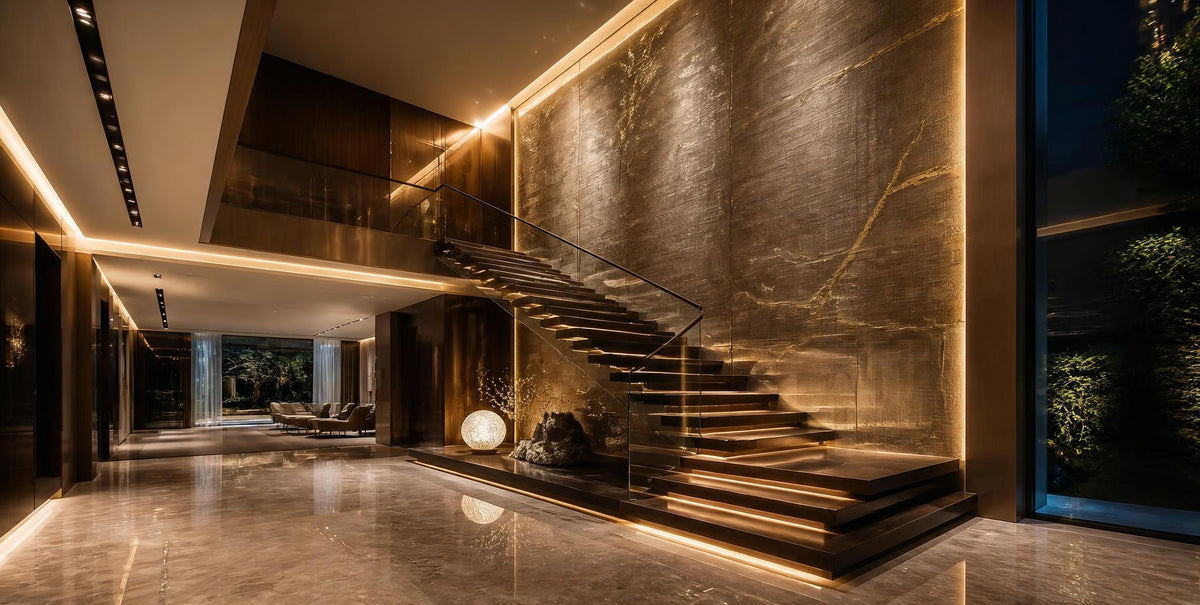
Staircase Wall
Staircases often create long, visually dominant wall surfaces.
A vertically oriented texture, mural or subtle repeating design can follow the movement of the staircase while maintaining continuity between floors.
Master Bedroom
The wall behind the bed is a natural location for wallpaper and can help anchor a larger bedroom.
Soft textile-inspired textures, muted patterns and warm neutrals can create a calmer visual effect.
Dining Area
Wallpaper can help define a dining area within a larger open-plan layout.
Where furniture is relatively simple, the dining wall may support slightly stronger texture or pattern than the main living zone.
Study or Private Lounge
Fine textures, darker neutrals, architectural patterns and restrained decorative finishes can create a more intimate atmosphere in enclosed spaces.


How to Choose Wallpaper for High & Large Walls
Large-scale walls should be evaluated differently from standard feature walls.
Consider:
- Viewing distance: the farther away the wall is viewed, the more important the overall pattern becomes.
- Pattern repeat: small repeats may become visually busy across a large surface.
- Vertical alignment: long walls and stairwells make pattern alignment more noticeable.
- Ceiling height: strong horizontal patterns can make a tall wall feel wider, while vertical movement can emphasise height.
- Lighting: directional lighting can make textured wallpaper appear more dimensional.
- Furniture scale: the wallpaper should remain proportional to large sofas, dining tables and built-in elements.
Ground Floor, Upper Floor & Wall Condition
Different floors in a landed home can experience different environmental conditions.
Ground-Floor Walls
Ground-floor and exterior-facing walls deserve careful inspection if there is any history of seepage, dampness or recurring mould.
Wallpaper should not be installed over an unresolved moisture source.
If there are warning signs such as dark patches, bubbling paint, musty odour or recurring staining, identify and rectify the underlying issue first.
Upper Floors & Roof-Adjacent Rooms
Upper-floor rooms can experience stronger heat gain, especially when located close to roof areas or exposed façades.
This does not automatically make wallpaper unsuitable, but wall temperature, ventilation and product specification should be considered when planning the installation.
Air-Conditioned Rooms
Air-conditioning can change room temperature and humidity while it is running, but it does not fix moisture trapped inside a wall.
Stable wall conditions and appropriate ventilation remain more important than relying on air-conditioning alone.
For a more detailed explanation, read our Wallpaper Humidity Singapore guide.
Wallpaper vs Paint for Landed Homes
Wallpaper and paint can both work well in landed properties, but they create different design effects.
| Factor | Wallpaper | Paint |
|---|---|---|
| Design variety | Patterns, textures, murals and decorative finishes | Very broad colour selection |
| Large-wall impact | Can create stronger visual depth across large surfaces | Creates a simpler and more uniform background |
| Texture | Wide range of tactile and visual effects | Usually flatter unless decorative coatings are used |
| Feature zones | Well suited to focal walls, staircases and selected rooms | Useful for large continuous background surfaces |
| Maintenance | Depends on the specific wallcovering | Depends on paint type and finish |
In many landed homes, the most balanced approach is to combine both: paint for background walls and wallpaper for selected architectural or feature areas.
See our Wallpaper vs Paint Singapore guide for a more detailed comparison.
Wallpaper vs Fluted Panels for Feature Walls
Wallpaper and fluted panels create very different effects.
Wallpaper is useful when you want pattern, colour or surface texture across a broad wall area. Fluted panels create stronger three-dimensional lines and a more architectural finish.
The right option depends on the room, budget, maintenance expectations and desired level of visual structure.
| Finish | Typical Design Role |
|---|---|
| Wallpaper | Pattern, texture, murals and broad decorative surfaces |
| Fluted panels | Three-dimensional linear detail and architectural emphasis |
| Paint | Simple background colour and visual continuity |


Installation Planning for Tall Walls & Staircases
High walls and staircase areas may require more installation planning than a standard room-height feature wall.
Important considerations can include:
- Safe access to elevated wall areas
- Protection of flooring and furniture
- Long vertical pattern alignment
- Wall preparation across multiple levels
- Lighting fixtures or railings that restrict access
- Working around stair landings and void spaces
The installer should assess access and wall condition before confirming the installation method and project schedule.
How Long Does Landed-Home Wallpaper Installation Take?
There is no single timeline that applies to every landed-home project.
A standard bedroom feature wall may require much less work than a tall staircase wall, large mural or several rooms across multiple floors.
The scope can increase when the project includes:
- High ceilings or void areas
- Large-scale murals
- Complex pattern matching
- Wall repairs or surface preparation
- Multiple storeys
- Built-in carpentry
- Several feature walls
A site assessment is the best way to determine the actual scope.
How Much Does Landed-Home Wallpaper Cost in Singapore?
Pricing varies widely because landed-home projects can range from one bedroom wall to several large surfaces across multiple floors.
The final quotation can depend on:
| Cost Factor | Why It Matters |
|---|---|
| Wallcovering type | Different materials, brands and design formats have different pricing structures |
| Wall dimensions | Large and tall surfaces require more material |
| Pattern repeat | Pattern matching can affect material quantity |
| Wall condition | Repair or preparation may be required before installation |
| Height & access | Tall walls and staircase areas may require additional access planning |
| Murals | Custom artwork and wall dimensions affect the material scope |
| Number of rooms | Whole-home projects differ significantly from single feature-wall installations |
For a more accurate quotation, provide MONLI with the wall dimensions, photos of the existing surface and the wallpaper design you are considering.
What to Check Before Ordering Wallpaper
- Measure each wall accurately: especially tall or irregular surfaces.
- Inspect wall condition: look for dampness, cracks, peeling paint or previous seepage.
- Confirm pattern repeat: this matters more across large wall areas.
- Check fixed elements: note switches, windows, railings, built-ins and lighting.
- Compare material samples: coordinate wallpaper with flooring and carpentry.
- Consider viewing distance: large walls should be evaluated from across the room.
- Plan installation access: tall walls and staircases may require additional preparation.
Common Landed-Home Wallpaper Mistakes
Choosing a Pattern That Is Too Small
Small repeating designs can become visually busy across very large wall areas.
Choosing Only From a Small Sample
A sample may show colour and texture but not how the pattern behaves across a double-height or wide wall.
Ignoring Wall Condition
Large feature walls should not be used to conceal seepage, unstable plaster or recurring dampness.
Using Too Many Competing Materials
Wallpaper, marble, timber, fluted panels and mirrors do not all need to compete in the same area. Decide which material should be dominant.
Forgetting Access Requirements
High walls and staircases can require more installation planning than standard room-height walls.
Ordering Before Finalising Carpentry
Built-ins can change the visible wallpaper area and affect pattern placement, so coordinate the two before confirming material quantities.
Frequently Asked Questions
Is wallpaper suitable for landed homes in Singapore?
Yes, provided the wall is dry, stable and properly prepared. Landed homes simply require more attention to wall scale, access, exterior-facing surfaces and variation between floors.
What wallpaper works well for a large living room?
Textured neutrals, stone-inspired finishes, linen effects and larger-scale patterns can work well because they provide visual depth without necessarily making the room feel busy.
Can wallpaper be used on a double-volume wall?
Yes, but pattern scale, wall dimensions, viewing distance and installation access should be considered carefully before selection.
Can wallpaper be installed on a ground-floor wall?
Yes, if the wall is dry and stable. If there is any history of seepage, dampness or recurring mould, investigate and rectify the underlying issue first.
Can wallpaper be used near an internal courtyard?
It depends on the degree of exposure. Standard interior wallpaper should not be treated as an outdoor or waterproof finish. Areas exposed to direct rain or persistent moisture require a different surface solution.
Should I use wallpaper throughout the whole landed home?
Not necessarily. Selective use often creates a more balanced result. Wallpaper can highlight living rooms, staircases, bedrooms and dining areas while paint or other wall finishes provide visual breathing space elsewhere.
Related Landed-Home & Wallpaper Guides
- Condo Wallpaper Singapore: Complete Guide
- Wallpaper vs Paint Singapore: Which Is Better?
- Wallpaper Humidity Singapore: Causes & Prevention Guide
- TV Feature Wall Wallpaper Singapore: Modern Design Ideas
Find the Right Wallpaper for Your Landed Home
The best wallpaper for a Singapore landed home should work with the architecture, wall scale, room proportions, lighting, flooring, carpentry, wall condition and way the space is used.
Start by identifying the walls that need the strongest visual treatment, then compare wallpaper samples at the appropriate viewing distance. For tall or exterior-facing walls, inspect the substrate and installation access before finalising the design.
Explore MONLI's Wallpaper Singapore collection, visit the MONLI showroom in Tampines to compare wallpaper textures and finishes in person, or WhatsApp +65 8112 4866 for product recommendations and quotation advice.


Share:
Condo Wallpaper Singapore: Complete Guide for Homeowners
Retail Wallpaper Singapore: Design & Material Guide